
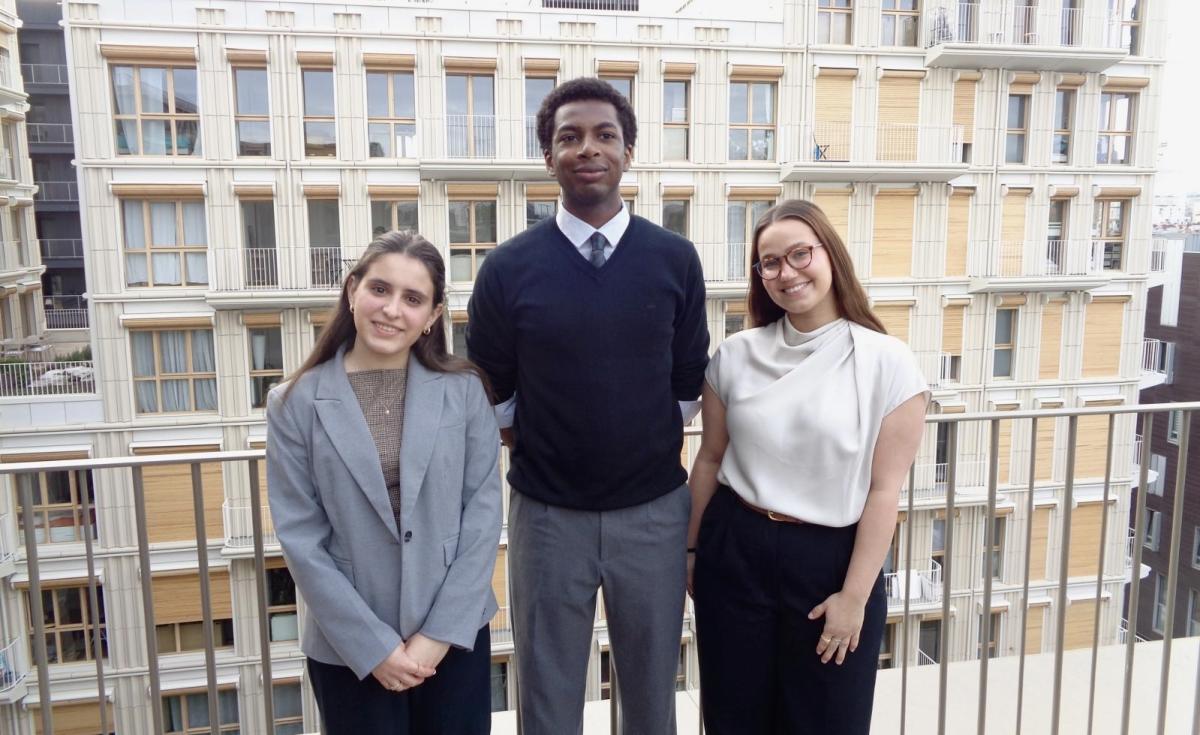
Each academic year, the Global Human Rights Lab selects a new cohort of qualified undergraduate students to provide research support for the Law School’s Global Human Rights Clinic (GHRC).
The Global Human Rights Lab is led by Pozen board member Anjli Parrin, Director of the GHRC, and Adi Radhakrishnan, Fellow, Lecturer in Law. Morris Tidball-Binz — the United Nations Special Rapporteur on extrajudicial, summary, and arbitrary executions and a Senior Visiting Research Associate at the Pozen Center — also guides the work of the Lab.
The Pozen Center has collaborated with Tidball-Binz for over two years, with his research spanning a number of topics within his mandate. At the beginning of 2026, he sat on a panel on "The Death Penalty and Torture" — an event which the Pozen Center cosponsored. Last month, Tidball-Binz had a report published by the UN titled, "The death penalty from the perspective of the prohibition of torture and other ill-treatment and the protection of human dignity," which can be accessed through the United Nations Digital Library.
Each year, undergraduate students in the Global Human Rights Lab work in small groups to conduct research and support various human rights initiatives under the guidance of Parrin, Radhakrishnan, and Tidball-Binz. This year, students developed country case studies to inform two reports published by the Special Rapporteur: the one on the death penalty as torture, and another on preventing and investigating unlawful deaths of older persons. Additionally, this April, the Pozen Center co-sponsored a convening in Paris with the UN Special Rapporteur’s mandate to develop Draft Principles on the Respect for and Protection of the Dead. Lab students supported and attended this meeting, which brought together interdisciplinary experts from around the world to create new global guidelines grounded in international human rights law to ensure that the dignity of dead persons is upheld.
Three students reflected on their experiences in Paris, and they shared a similar takeaway — human rights work is often in the details. Read about their experiences below.
Isabel Alia-Arias
Before going on this trip, I understood — academically — how international human rights work is complex, collaborative, and sometimes slow-moving. However, the work I did in this two-day conference helped transform that understanding into something tangible.
As part of the undergraduate team, I was responsible for taking detailed notes on the proceedings that would later inform the editing of the Draft Guiding Principles. This role gave me the opportunity to observe in real time how a group of roughly 20 experts, from diverse professional and geographic backgrounds, worked together to shape the language and structure of the document.
What struck me the most was the level of care devoted to even the smallest details — from word choice to the sequence of ideas — which were all carefully debated. These discussions were not just semantic choices but reflected deeper questions about universality and the real-world implications of human rights frameworks.
In human rights classes, I had often heard that international documents take time because they incorporate multiple perspectives to be truly effective and broadly applicable. When I saw this process firsthand, I came to understand that disagreement was not a barrier but an essential part of stronger, more inclusive principles. The room was a space of negotiation where everyone played a part.
This experience also taught me the human dimension of human rights work, which would have been difficult to grasp in a classroom. Beyond theories and legal frameworks are individuals who bring their own expertise and lived experiences to the table. As I saw how they listened, challenged one another, and ultimately collaborated, it reinforced the idea that human rights progress needs dialogue.
I strongly encourage undergraduate students to step outside of the classroom whenever possible. Engaging directly with practitioners and processes offers a depth of understanding that cannot be replicated through readings and discussion alone. My time in Paris showed me that human rights work is both meticulous and meaningful, and it is possible to contribute in small and significant ways.
When I saw this process firsthand, I came to understand that disagreement was not a barrier but an essential part of stronger, more inclusive principles.
Remy Simon
I am grateful for the opportunity to have gone to Paris last month. I experienced direct exposure to how the ideas of human rights are negotiated in practice, which was incredibly valuable. What particularly stood out was the amount of focus on details.
Experts spent much of the time debating specific wording and other small decisions that ultimately will end up shaping much larger outcomes. Being exposed to that process made it clear to me that UN Guiding Principles are not meant to be perfect, and the people drafting them know that, too.
Much of the debate came from a shared commitment by everyone there, despite their disagreements, to create something that is useful across different contexts — even when that meant accepting limitations.
One thing that I learned from this opportunity was how to disagree in productive ways. In my classes there are plenty of opportunities to share different thoughts and perspectives, but there are not many actual disagreements.
During these meetings in Paris, there was almost always disagreement between people with deep expertise in their fields; however, it was almost always productive. Those disagreements and the subsequent resolutions are what moved the conversation forward. It helped me understand how I can disagree in more productive ways in the future.
For students considering similar experiences, I would strongly recommend taking the opportunity if it is available. Being involved in the practice of human rights changes how you understand it. Whether that involvement is at the level of UN drafting or something local like a mutual aid network, that engagement helps orient the education that we receive. It helps to ground our learnings in real people’s experiences, needs, and wants — which is invaluable to affect positive change in the lives of others.
I began to understand human rights not as an abstract field of study, but as a living, collaborative practice shaped by voices that rarely seem to share the same room.
Ophra Atar
During my time in Paris, I began to understand human rights not as an abstract field of study, but as a living, collaborative practice shaped by voices that rarely seem to share the same room. Around the table sat forensic archaeologists, pathologists, legal scholars, religious experts, and philosophers, each bringing a distinct lens to a shared moral project: how to advocate for and articulate the necessity of the protection of the dead.
Witnessing this convergence of disciplines was profound. It affirmed that human rights work at its core resists narrow definitions and instead builds itself up from the careful inclusion of perspectives.
What struck me most about the experience was the depth of attention given to even the smallest details. During one long stretch of the first day, the group deliberated over two words in a single article’s title. To an outsider, this might seem excessive, but in that room, it felt necessary — like an act of respect for the gravity of what was being created. Every word carried weight, shaping how dignity, accountability, and care would be understood across contexts.
This experience reshaped my understanding of what it means to work in human rights. It is not only about conviction and desire to initiate change, but about patience, humility, and the willingness to engage across differences. The attendees revealed a unique level of dedication that is difficult to grasp in a classroom, where outcomes are often emphasized more than the painstaking processes behind them.
As undergraduates, our role was to document the meeting in real time. Over two days, we collectively produced around 40,000 words of notes, striving to capture every argument, nuance, and shift in perspective. This task made us active participants in the process.
Our collaboration as an undergraduate group was thrilling and mirrored what we saw around us: thoughtful disagreement, careful listening, and a shared commitment to producing something meaningful. There was a phrase often repeated among us throughout the trip, that we were “in the room where it happens”. A nod to Hamilton, we were not just observing change from a distance but contributing to it in a tangible way.
One evening, a law student posed a question to us that has stayed with me: after being present in that room, could we see ourselves in those roles one day? For me, seeing the work up close transformed it from an idea into a possibility.
There is no substitute for witnessing this process firsthand, for seeing how change is negotiated, drafted, and refined by people deeply committed to its impact. These experiences do more than inform. They show you not just what human rights work looks like in practice, but the skills, commitments, and responsibilities it requires, and the kinds of specialized roles you can realistically grow into over time.