
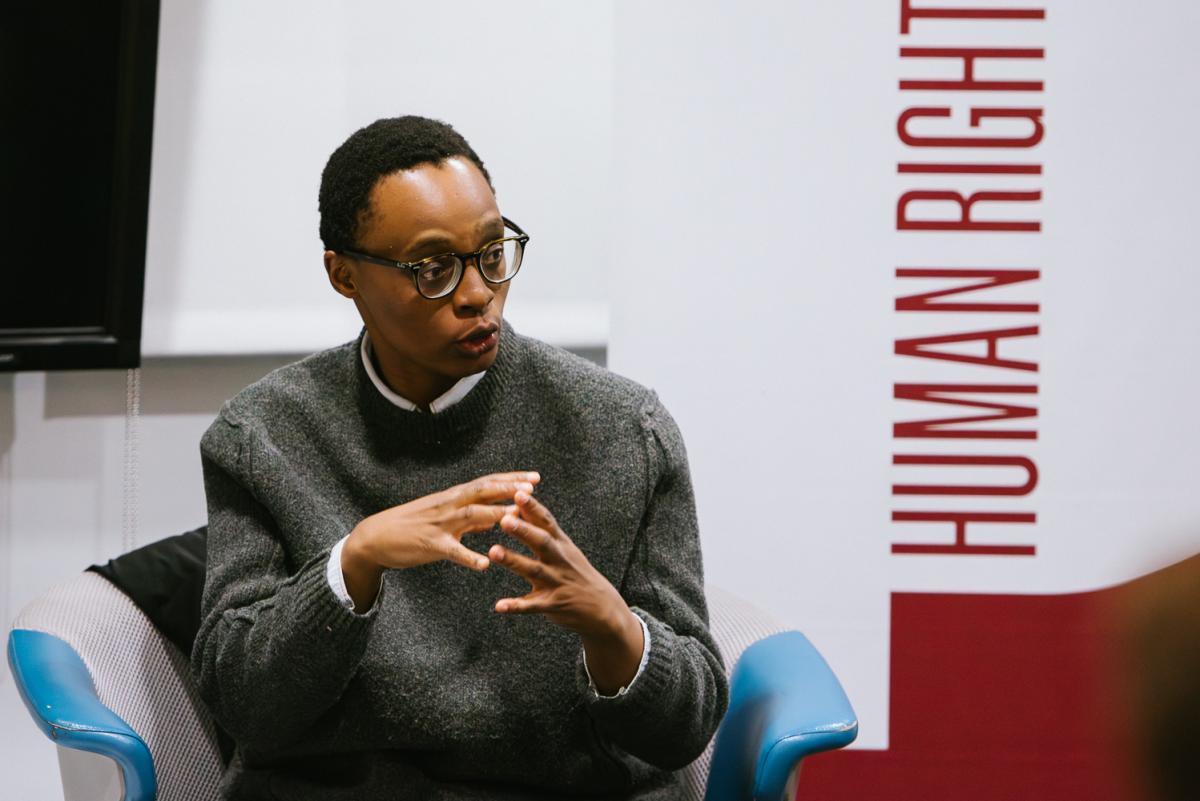
Director of practice Emmah Wabuke, speaks with undergraduate students at an event on February 2, 2026.
In Brief
- The Pozen Center is excited to announce a new course for Spring 2026, Rights Under Strain: A Practicum (HMRT 21905), taught by the director of practice, Emmah Wabuke.
- The practicum offers an immersive, hands-on exploration of how anti-rights actors shape discourse, law, and public policy across Africa, and how rights-affirming advocates can respond. Students will directly collaborate with a Kenyan NGO partner and with the Leitner International Human Rights Clinic at Fordham Law School.
- The course also serves as a pathway to a competitive year-long internship that may include supervised field engagement in Kenya, partnership meetings, and contributions to ongoing monitoring and advocacy efforts.
This Spring Quarter, the Pozen Center is offering University of Chicago students a new opportunity to engage theory and practice. Rights Under Strain: A Practicum (HMRT 21905) offers students the unique opportunity to undertake human rights work that will have an impact far outside of the classroom.
Director of practice Emmah Wabuke explains why the issue is important and requires further examination.
Across regions and issue areas, human rights norms are operating under growing strain. Recent years have seen a convergence of developments that signal not isolated setbacks, but a broader contraction of rights protections and the systems that sustain them.
In several African states, the introduction and expansion of anti-homosexuality legislation have deepened the criminalization and marginalization of sexual and gender minorities. In the United States, the overturning of Roe v. Wade has marked a significant rollback of reproductive justice, with cascading effects that extend well beyond national borders, shaping global policy debates, funding environments, and normative expectations.
At the same time, the restructuring of USAID and the wider dismantling or reduction of foreign aid by multiple governments have weakened critical support for rights-based programmed worldwide. Together, these shifts illustrate a moment in which rights that were once assumed to be consolidating are increasingly contested, deprioritized, or rendered fragile.
Rights Slowly Eroded
Understanding rights under strain requires attention to how backlash unfolds. In many settings, established norms, particularly those related to reproductive justice, bodily autonomy, and the rights of sexual and gender minorities are no longer treated as settled. Instead, they are subjected to renewed scrutiny, reframed as exceptional claims rather than universal entitlements, or deprioritized in moments of political or economic uncertainty. These dynamics often emerge incrementally, making them harder to identify and respond to until significant ground has been lost.
The strain on rights is particularly pronounced in the Global South, where local debates are increasingly shaped by transnational currents of rhetoric, funding, and strategic influence originating in the Global North. Discourses that question or narrow rights related to reproductive justice and sexual and gender diversity are frequently resourced, amplified, and exported across borders, even as they are framed locally as expressions of cultural or moral authenticity.
In post-colonial contexts, these narratives intersect with histories of external intervention and ongoing struggles over sovereignty and identity, creating fertile ground for the reframing of rights as foreign, excessive, or socially disruptive. As a result, resistance to rights often manifests not through formal rejection, but through stalled implementation, selective enforcement, and the quiet hollowing out of protections. Rights may continue to exist in law, while their substance and reach are steadily diminished in practice.
Supporting Rights Through Action
In this environment, monitoring becomes a critical tool. Tracking how rights are debated, interpreted, and applied allows advocates, researchers, and institutions to identify early signs of erosion. Monitoring backlash is not only about documenting legal regressions, but about understanding shifts in discourse, policy emphasis, and public framing. It is through these quieter transformations that rights are often most effectively weakened.
Yet one of the central challenges in responding to rights under strain lies in communication. Legal standards and advocacy strategies alone cannot counter backlash if they are not accompanied by compelling narratives. Rights claims frequently rely on technical language that struggles to resonate beyond specialist audiences, leaving space for competing narratives that are simpler, emotionally charged, or more politically expedient.
Strengthening narratives around rights is therefore essential. Effective communication can help situate rights within broader stories of dignity, fairness, and social justice, making clear their relevance to everyday lives. Narrative-building can complement legal and advocacy work by reinforcing why rights matter, how they are connected, and what is at stake when they are weakened. In contexts where norms are under pressure, narratives are not merely explanatory tools; they are protective ones.
As rights continue to operate under strain, sustained attention to monitoring, communication, and narrative generation will be vital. Protecting human rights in this moment requires not only defending legal frameworks but actively shaping the stories that sustain them.